Written November 2006
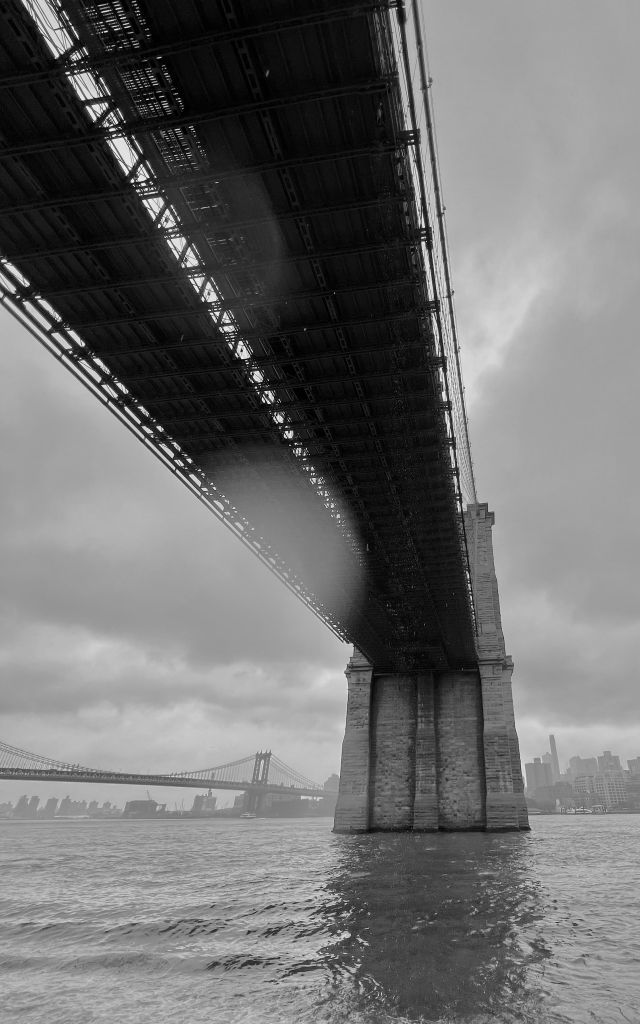
The bridge that divides the city is also the bridge that connects it. Over a river that gurgles in childish speech, flowing and smoothing out the roughness of the rocks around it, the bridge, despite its rare usage, is the only thing the east and west sides of the city have in common.
The east is inhabited by a café society and run by people who pay more attention to lines on a graph than to their children. There are more coffee shops and high-class restaurants in that division of the city than there are pigeons, which seem to have picked up on the contagious greater-than-thou aura the citizens ooze and are more inclined to stay perched high atop buildings than pecking around their feet.
The west, which is quite the polar opposite, is comprised of aged bohemians. Here, fireplace mantles of parents hold more pictures of Billie Holiday than of their own offspring. Alleyways are museums of graffiti, and the man strumming on an out-of-tune guitar on the bus stop bench is probably just as wealthy as the man running the bank in the east.
It is, then, no lie to say that this particular city is hardly a city, but rather two completely separate communities. The acknowledgement they have of one another is limited only to the running joke of saying, “Well, why don’t you move east, then?” or “Why don’t you move west?” when someone does something outside of the cultural norm.
The bridge is simply there to underline their division.
On the eastern bank of the river sits a young man. He is tall, with dark hair and sorrowful eyes that reflect the constant rippling of the water he finds so interesting. The spot where he is sitting is worn, the grass lies flat and flowers prefer to go around it. He has sat himself down beside the river so many times that he has become a permanent fixture of sorts; a tree that may wander at times, but who always returns to sink his roots into the welcoming soil of his past, present, and future. Behind him is his family, his friends, his school, his job, his girlfriend… He knows that none of them are wondering where he is, though they have no idea. He knows that by having them, he is only going through the motions of being human. At sixteen, his eyes no longer sparkle and he is no longer uncertain. At sixteen, he knows where he is to go with his life, and he knows that no motion of rebellion will change it. The dogma of eastern society binds his wrists behind his back and forces him to walk the plank, a plank that will drop him into the cold, stabbing waters of adulthood. The funny thing is he already feels like he’s drowning.
On the western side of the divide walks a young man. He is of medium height with light hair that blows into his face in wisps whenever the wind whispers a secret into his pierced ears. His pupils are dilated despite the fluorescent street lamps, so only a thin border of gray color is left to show that he is human. He is thin, all angles and bones so he looks more like a stray cat than a healthy middle-class teenager. The rod that pierces his tongue clicks against the back of his teeth as he takes each step, providing the consistency that his life lacks. His slender fingers play with the seam of his worn pants, which are too big for him, while his sweater is too small and does little to keep out the cold. His path changes from concrete to mowed grass as he leaves only a letter behind. No school to question his absence, no parents interested enough to call the police, no girlfriend to send postcards to, no job to be fired from… A letter with only three words scrawled in the lower left corner of the page. His path changes from mowed grass to wild weeds and flowers.
Above them, the night sky is a dirty orange. The light pollution from the city has floated up to the heavens and, over years and years of endless spiraling, has rusted the once-black night sky. It bears down upon them with the grace only ethereal beings have, but with the ferocity of a desperate prisoner. It threatens to tear them apart as swiftly and soundly as when they fell from the womb into the hands of a doctor that had hundreds of babies before them and hundreds of babies after; apathetic, anonymous, and masked.
Behind them each is a sea of dotted lights. Behind them each is a house, but not a home. Behind them each are memories, passing thoughts, childish hopes, and forlorn dreams that drifted off into the rusted sky like red balloons and popped when they could no longer retain what they were filled with, so that the only thing left is shreds.
One stands up and one stops. There is a moment when they realize their balloons popped together. There is a moment when the shreds begin to fall to the Earth like blossoms in a spring breeze, rocking and swaying in the wind like a baby in a cradle.
Their feet move simultaneously. One’s shoes are neatly tied and one’s shoes are worn and muddy, until both pairs stop right in front of each other and you can’t tell in the darkness which is which. Toe to toe, face to face, east to west.
There is a moment when no words have to be spoken, when dilated pupils speak to sorrowful orbs in no language known to any terrestrial being. There is a moment when they become one, when broken skin meets bruised spirit. There is a moment when they begin to fall, when their hearts beat in sync, when one’s back is to the sky and the other’s is to the water, but both eyes are closed and both bodies are held in another’s arms.
 j.k. armstrong